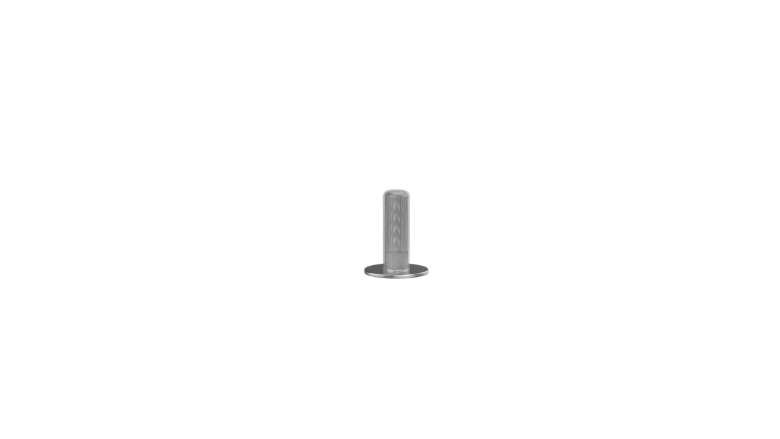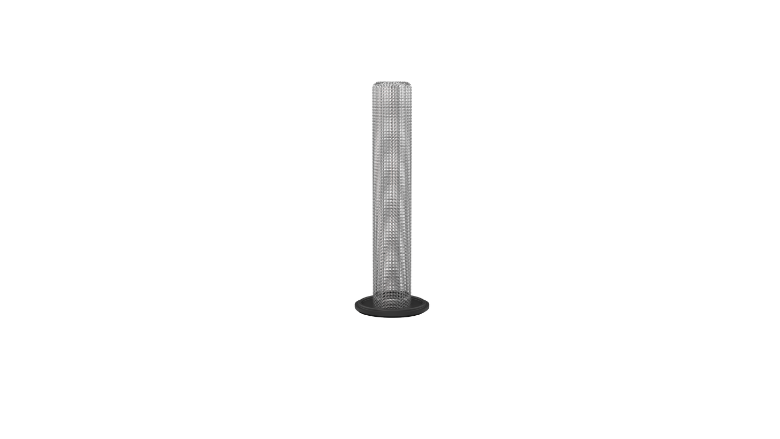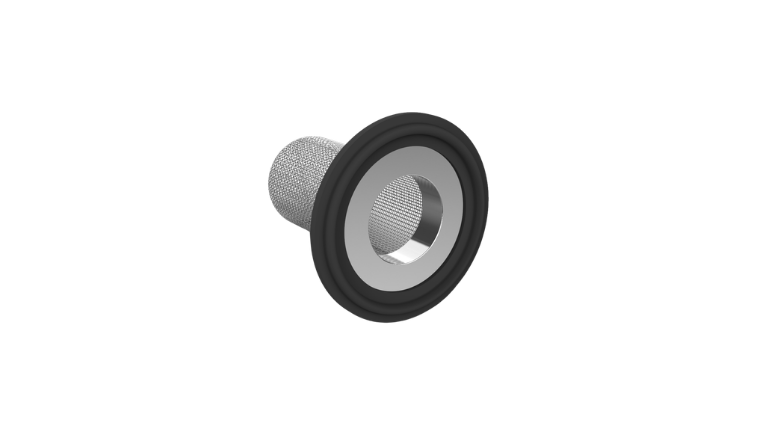
Sock screens offer a greater soil collection capacity than standard flat screens. If the capacity of a standard flat in situ filters is not sufficient then the Sock screen is a good alternative. They are available in 150 mm (6in) and 50 mm (2in) lengths. All of our Sock screens are produced in house at Ultrapharma (The Netherlands). After production they will be chemically cleaned to avoid impurities. The Sock screen is made of 3.1 certified stainless steel and supplied with:
Removable elastomeric gasket / Removable PTFE gasket / Removable Steam-Flon® gasket. All materials will be supplied with Heat number/ Lot number. Bonded PTFE or Steam-Flon® on request, a longer delivery time may apply.
Ensuring product purity and process integrity across the pharmaceutical and biopharmaceutical industries.
European leader in FDA-compliant gaskets and validation components. Ensuring product purity and process integrity across the pharmaceutical and biopharmaceutical industries. Our screen gaskets are not used the same way as conventional filters, although they can be considered a filter. Conventional filters are built differently and have many layers to prevent particles to pass through, these can reach efficiencies of almost 100%. A particle comes in many different shapes.
For example, a hair has a diameter of Ø 0,1 mm but the length can be centimetres long. If the hair arrives perpendicular to the screen it might pass a 100 mesh screen. With a conventional filter, the second or third layer will prevent the hair to pass. Retention’s of standard screens are calculated according to international standards using perfectly round glass spheres. Our screens are only one layer and therefore they cannot be considered the same as a filter. Each screen gasket has a high-performance gasket made out of one of the validated compounds that we use for our standard Sanitary Gaskets range.
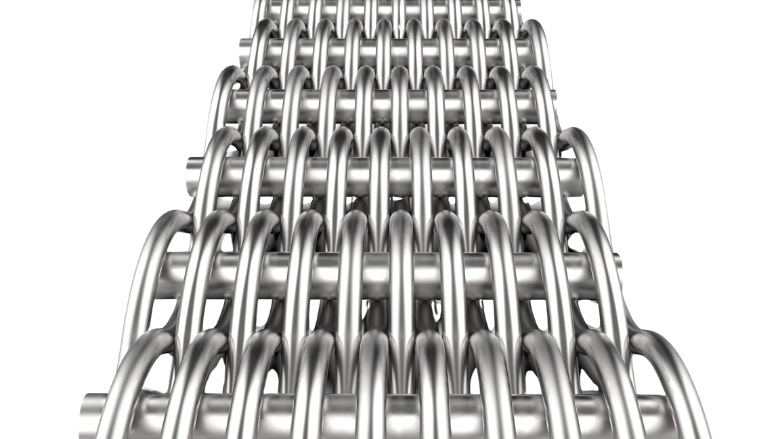
When the mesh of plain weave is above 80×80 the material will be to thin and fragile for a Sock screen. This is why we choose for a different weave when finer filtration is needed, the Dutch weave. This weave has a high filtering level and high pressure load resistance.
Instead of plain weave, the warp and weft wires in Dutch weave are not interchangeable. This weave has a coarser mesh and thread in the Warp direction and a finer mesh and thread in the Weft direction, resulting in a very compact, sturdy mesh with great strength. The surface of the Dutch weave is closed so that the filtration occurs at the point where warp and weft join.
Because filters in your process equipment can be an obstruction to the flow, depending on the Mesh Open Area (Ao), they can cause the phenomenon known as pressure drop. Simply put, pressure drop is the difference in total pressure between two points in your system. In our case it describes a change in pressure from point A (before filter) to point B (after filter). With filters, the higher the drop, the greater the impact on performance.
When using a flat screen we can calculate the pressure drop (Mbar) using the Mesh Open Area (Ao) and the Volume flow (m³/h) in your system. This pressure drop is calculated with unused screens, you can imagine that when the screen gets clogged the Pressure Drop will rise. As you can see in the table below, less opening means more pressure drop.
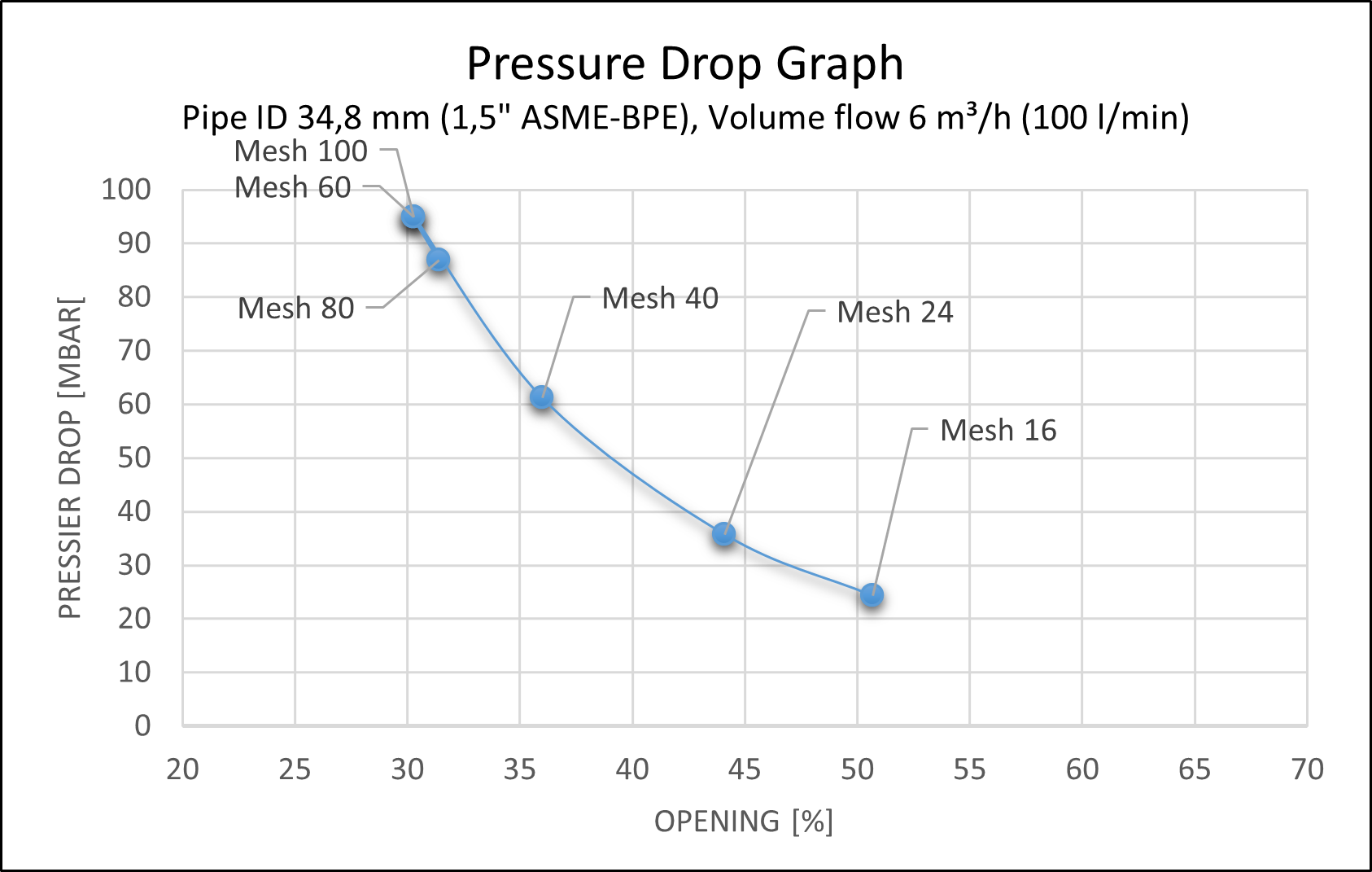
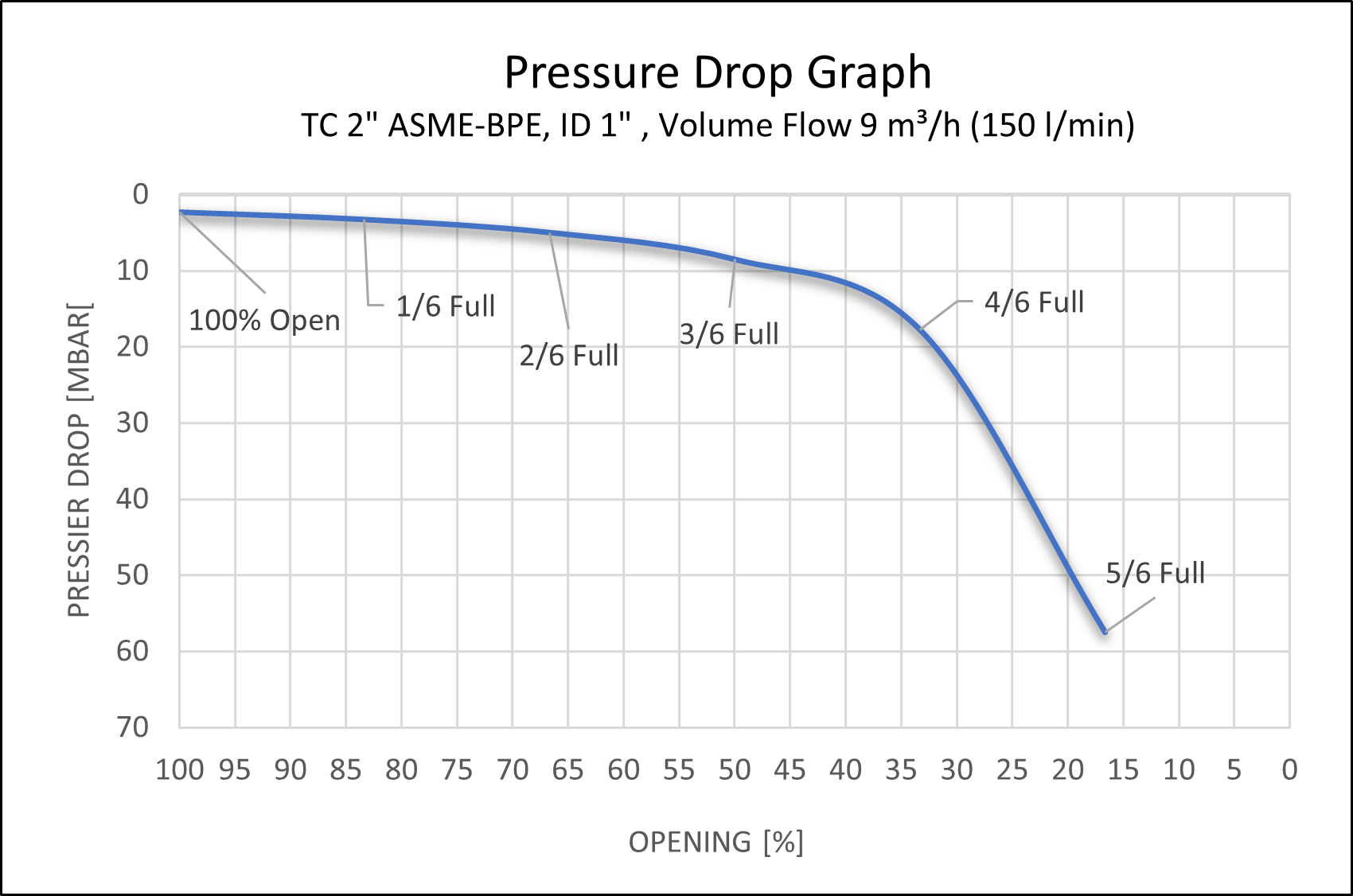
Clogged up screens can have a large impact on the performance of your system, because they can cause high Pressure Drops. This is where Sock screens have the advantage. Sock screens can be partially clogged up, but still don’t have a large pressure drop. In the graph you can see the Pressure Drop of a 1.5in, 40 mesh, length 150mm Sock screen when it gets clogged up more and more. You can notice that when it’s 5/6 full, the pressure drop is still the same as a flat mesh 40 screen.
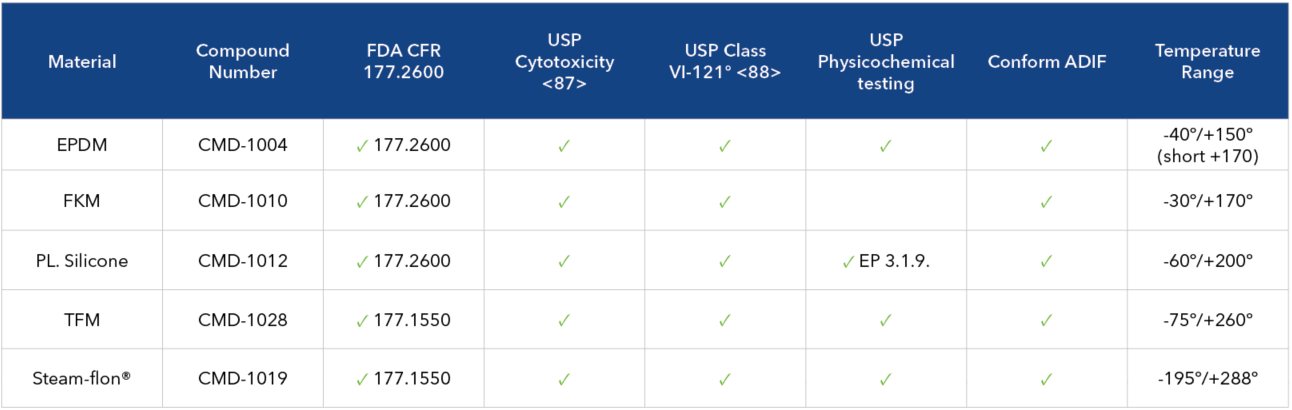
This table provides a comprehensive overview of the technical specifications and regulatory compliance for various industrial sealing and gasket materials. It serves as a selection guide for industries with high-purity requirements, such as pharmaceuticals, biotechnology, and food processing.
Our technical team is ready to help you select the right solution for your application